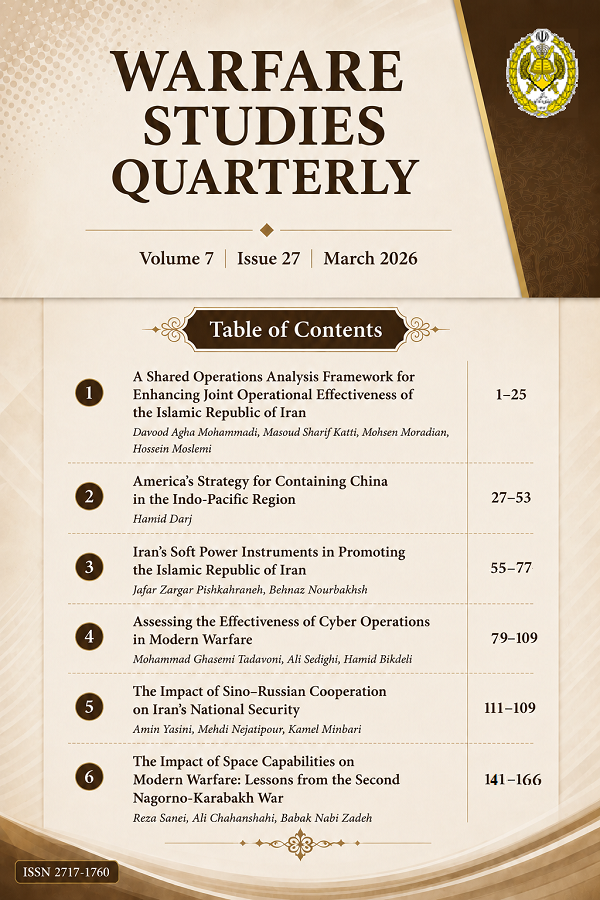
The Second Nagorno-Karabakh War (2020) exemplified the transformation of modern land warfare, where the integration of conventional ground combat systems with advanced technologies played a decisive role in operational success. This study employs a descriptive–analytical approach, combining qualitative data (document analysis, military reports, and expert interviews) and quantitative methods (questionnaires, CVR index, and Cronbach’s alpha) to examine the role of ground combat systems in achieving operational superiority. Findings indicate that armored units, artillery, combat engineering, and logistical systems remain critical, yet their effectiveness is limited without coordination with unmanned aerial vehicles, electronic warfare, and information systems. Azerbaijani forces achieved dominance largely through the synergy of traditional systems with modern technologies, particularly precision-guided drones and network-centric warfare capabilities. The study highlights the necessity for revising doctrines in command and control, logistics, and technology adoption for the Iranian Armed Forces, emphasizing that future battlefield success requires the integrated operation of firepower, command and control, and resilient support systems. Second Nagorno-Karabakh War, Ground Combat Systems, UAVs, Electronic Warfare, Military Doctrine
jahanshahi, A., nabizadeh, B. & sane, R. (2026). Explaining the role of ground combat systems in the Second Karabakh War. War Studies, 7(27), 141–166. https://doi.org/10.22034/qjws.2026.2073722.1311
MLA
jahanshahi, A., nabizadeh, B., & sane, R. "Explaining the role of ground combat systems in the Second Karabakh War", War Studies, 7, 27, 2026, 141–166. doi: 10.22034/qjws.2026.2073722.1311
HARVARD
jahanshahi, A., nabizadeh, B., & sane, R. (2026). 'Explaining the role of ground combat systems in the Second Karabakh War', War Studies, 7(27), pp. 141–166. doi: 10.22034/qjws.2026.2073722.1311
CHICAGO
jahanshahi, A., nabizadeh, B. & sane, R., "Explaining the role of ground combat systems in the Second Karabakh War." War Studies, 7 27 (2026): 141–166, doi: 10.22034/qjws.2026.2073722.1311
VANCOUVER
jahanshahi A., nabizadeh B., sane R. Explaining the role of ground combat systems in the Second Karabakh War. War Studies. 2026;7(27):141–166 (In Persian). doi: 10.22034/qjws.2026.2073722.1311